Sheridan Ruth

Surprising Challenges and MUST READ Books For Profitable, Anxiety-Free Business on Polyvagal Theory, Nervous System Regulation, Trauma Healing and Stress Relief

Podcast

Listen Wherever You Get Your Podcasts

By the end of this podcast, you’ll discover:


  • 17 surprising challenges you face when building a profitable, anxiety free business challenges and  the best books to read to overcome them 

In this episode, you’ll discover:

  • The book you can read this weekend that saved me from chronic PTSD when nothing else was working 

  • The shocking effect of emotions on burnout, stress and your overall well being

  • How to pick business books to read, that will ACTUALLY get you closer to your goals instead of just wasting time and energy 

Listen to the episode to learn the challenges, and then once you know which book corresponds to your challenge you can pick the book. The titles are listed below to make it a little easier to search for when shopping. 

  1. The Compound Effect – Darren Hardy Main challenge: 

  2. The Big Leap – Gay Hendricks

  3. Anchored – How to Befriend Your Nervous System Using Polyvagal Theory –  Deb A. Dana

  4. The Body Keeps The Score  – Bessel van der Kolk

  5. Happy Healthy Sexy  – Katie Silcox 

  6. Burnout: The Secret to Unlocking the Stress Cycle – Amelia Nagoski

  7. The Biology Of Belief: Unleashing The Power Of Consciousness, Matter And Miracles – Bruce H. Lipton

  8. You Are The One You’ve Been Waiting For – Richard Schwartz 

  9. The Power of Focus – Jack Canfield  — Dhyana 

  10. The Red Tent by Anita Diamant

  11. Textbook of Ayurveda by Dr Vasant Lad | Volume 1

  12. Non Violent Communication – Marshall Rosenburg

  13. Atomic Habits – James Clear 

Tell me what you’re reading on Instagram! 

www.instagram.com/_sheridanruth_ 


TRANSCRIPT:

[00:00:00 ]By the end of this episode, you will discover the 17 surprising challenges each person faces when building a profitable anxiety free business and the corresponding book recommendation I have for you to read depending on which one you’re currently overcoming. [00:00:17] You’re about to discover a book that you can read this weekend that saved me when I was in the depth of my chronic PTSD and nothing else was working the shocking effect of emotions on burnout stress and your overall well being and my little secret to maintaining a business that works and moving focusedly towards your goals instead of just running your wheels and wasting time and energy [00:00:56] I’m sitting here with you Hot chocolate and it’s really, [00:01:00] really yummy. And I’m really excited to get into these. This summer for me has involved a lot of book reading, which has been really, really cool. And it’s also led to, , you guys actually asking me for some guidance around books. Disclaimer, my work is really about the importance of embodiment. [00:01:18] I actually started making this. [00:01:20] List just because I had a couple of you asking for like a book list and then I was looking through some of the book recommendations I had and I thought it would be helpful to correspond them to like a why you would read each book or what each book is going to help you with specifically what challenge you might be experiencing that will help, you know, if this is a good book to put your energy into and to prioritize. [00:01:42] So I’ve written down the challenges and they’re in no particular order. Let’s just get into it, hey? So, challenge number one, not knowing where to focus. Now, there’s this, um, like energy, there’s this concept in [00:02:00] yoga therapy, and the word is dharana, dharana, dharana, should I say that correctly? Dharana in Sanskrit, and it means focus, so it means single pointed attention, and focus is such an important thing. [00:02:14] You’ll see I speak about it a lot, , when you’re working with me. In that we need to kind of focus one on one thing or a few things at a time in order to see change. So in yogic philosophy, in the way that I’ve experienced the, the actual experience of this, this single point of focus, when you focus so much on one thing, what seems to happen is things. [00:02:40] So that you achieve, or you’re kind of magnetized towards this one thing. It’s like, you’d be kind of enter into this little vortex and you’re pulled towards this one thing. And a lot of us have this, the problem of the challenge that we enter is I don’t know where to focus. Where do I put my time? What do I do? [00:02:57] What do I focus on? And so if [00:03:00] you’re asking yourself this question of like, I don’t know where to focus, I actually want to encourage you to read the. Book the power of focus by Jack Canfield. And it’s going to be more clear to you at the end of the book. Why I’m going to recommend that you read this book. [00:03:17] But if you’re asking your question, I don’t know where to focus. I want you to read the power of focus by Jack and maybe. Yeah, I’m going to let that one be a little bit mysterious as to why, cause it seems almost like a little bit counterintuitive. , you probably want me to just tell you where to focus, right? [00:03:33] No, I’m going to ask you to read the power. , focus, and then come back to that same question. I know the challenge that a lot of people face and that I’ve certainly faced in the past, or sometimes still pretty regularly, to be honest, is. Not knowing if it is enough not knowing if what I’m doing is enough if you are sitting and you’re like I don’t know if this is enough. [00:03:55] I don’t know if this is enough. I don’t know if this is enough or You’re not sure [00:04:00] what is going to be enough I want you to read the compound effect by Darren Hardy the compound effect Completely changed the way that I see so many different things in my life I think a part of me was already living according to these philosophies. [00:04:12] Maybe it’s because I’m a projector in human design I don’t know but Yeah, go ahead and read the compound effect because It’s going to help you have a real deep sense of, well, what is enough and what isn’t enough. And it’s going to bring you more confidence and ease at the end of your day to be able to say, yes, this was enough or no, it actually did need to be a little bit more or a little bit different. [00:04:38] The third challenge that you might be experiencing is maybe some anxiety or you have a lot of like, this is the slightly different. The third challenge you might be experiencing is. That you’re having a lot of worry and concern and anxiety or like unexpected things happen. It feels like you just can’t get ahead. [00:04:58] It feels like as soon as things [00:05:00] start happening, you’re really worried about it, you’re self critical or some drama happens, like it just feels like you can’t get ahead. If it feels like you can’t get ahead, I want you to read The Big Leap by Gay Hendrix. That is a book that I have. Recommended quite a few times, um, that we have numerous podcast episodes on it. [00:05:22] Um, number 66, I think is how to prime your nervous system for more success. And I referenced this book. I want you to read, if it feels like you can’t get ahead, I want you to read the big leap by Gay Hendricks. The next one, number four, the challenge you might be experiencing is a lot of anxiety, depression, and self criticism. [00:05:42] Or like maybe possibly some complex PTSD, such as what I’ve experienced, a lot of relational trauma. I want you to read Anchored, How to Befriend Your Nervous System Using Polyvagal Theory by Deb Dana. This is for you [00:06:00] if you just, you haven’t a bit of, you’re struggling a little bit, um, there’s a lot of pain inside, um, you’re having thoughts that are uncomfortable and maybe you’re tired and you don’t really know what to do. [00:06:16] And it feels like it might be even a little bit bigger than you sometimes. So I’m recommending anchored, how to prevent your nervous system using polyvagal theory by Deb Dana, because when I was really healing my complex PTSD, , Deb Dana’s work was a big lifesaver. I really like the way that she relates to polyvagal theory. [00:06:36] She is not. Like the founder of polyvagal theory, , Stephen Porges is, and he does have a book on called, I think, polyvagal theory, which is a wonderful book. However, I really appreciate Deb Dana’s approach to it. I think she is very nurturing, very nourishing. Um, and That nourishing element is really nice when you’re healing this type of thing. [00:06:58] So go ahead and read Anchored, How to [00:07:00] Prevent Your Nervous System using Polyvagal Theory by Deb Dana. Now, if you’re experiencing a lot of repeating patterns and thoughts that harm you, and especially if you’re a little bit more new to the embodiment and somatic world, you absolutely have to read Body. [00:07:16] The Body Keeps the Score by Vessel van der Kolk. The Body Keeps the Score is a classic, it’s a must read. If you haven’t read it, you need to go and read it. Every single person on the world needs to read this book. It is going to explain to you essentially how the body keeps a score and how working with the body is going to change the way that you experience your world. [00:07:38] If the challenge you are experiencing is a lack of Like, it’s like this lack of libido, lack of creative energy, kind of feeling like you’re pulling from a well of nothing. Maybe you’re actually experiencing some physical, um, discomfort, heartburn, IBS, constipation, headaches, migraines, dry skin, eczema. If you’re just feeling [00:08:00] really bleh, like bleh. [00:08:04] I would really encourage that you read Happy, Healthy, Sexy by Katie Silcox. Katie Silcox is the person that I learned Ayurveda through and this is the first book that I read of her work. It’s a really awesome book. It’s going to give you an insight into your nervous system and your body. It’s kind of the, the Ayurveda is the backdoor of nervous system work that I like to use. [00:08:25] Um, so go ahead and read Happy, Healthy, Sexy. She has recipes in there. She has meditations in there. Um, and she has theory in there. She has education. She has personal stories. It’s just, it’s a vibe. It’s, it’s an awesome, awesome book. I highly recommend it. You’re going to walk away feeling happier, healthier, and sexier, even if you’re a boy, but it’s kind of written more for women. [00:08:43] But yeah, the other one that I recommend, especially as Ayurveda is your thing is actually the textbook of Ayurveda by Dr. Vasant Ladh. Volume 1. Volume 2 is really great, but you need to read Volume 1 first. This textbook is actually what I used [00:09:00] to study Araveda and it’s a little bit complex, but Dr. [00:09:03] Ladd has this poetic way of writing about elements and philosophy and the body in such a way that it’s actually really easy to understand and he makes the body just feel like a poem that is rolling off of your lips. . Oh, it’s a really, you know, I keep it, I have a copy on with me at all times. If you’ve ever been in my office or in my bedroom, you’ve seen the big yellow book. [00:09:26] I reference it. I love it. Um, It’s really, really beautiful. I’ve literally lugged this book around this big textbook around so many different countries. It’s a, it’s a great book for understanding your body and understanding how to nurture your body so that it can do more of what you want to do in your life. [00:09:46] Okay. Saying that if your other challenge is that you’re just feeling burnt out, you’re burnt out, burnt out, burnt out, or you know that you have tendencies to burn out. Um, and particularly if you’re doing. A lot. I would say this, [00:10:00] especially for people who are possibly listening and working like a nine to five job or that you have a lot on your plate, maybe you’re studying something like that. [00:10:10] I would really recommend that you, what you read the book, I listened to this book, but you read or listen to the book, burnout, the secret to unlocking the stress cycle by Amelia Nagoski. This is a really wonderful book that really does a great job explaining burnout and how we need to work with our emotions to avoid it. [00:10:34] You guys know a lot of the work that I do is around emotions. My clients access a tool which is called the Emotional Alchemy Tool and we do this because it is the key to our success. Unlocking the stress cycle and avoiding burnout. Amelia Nagoski and her co writer, I think, or co study, she did studies with or something, also have a wonderful podcast episode with Brené Brown. [00:10:59] If you [00:11:00] Google Brené Brown burnout interview, you’ll probably find it. I think it’s, it’s longer, but it’s really worth the listen. The next challenge is not knowing how to make sustainable change and doubting the science behind the recommendations that the coaching industry actually has for you. So there’s two things here, not knowing how to make sustainable change, and then when people recommend to you, Oh, you do it like this, actually doubting the science, basically doubting and say, like, does this stuff work? [00:11:32] You’re going to go ahead and read The Biology of Belief, Unleashing the Power of Consciousness, Matter, and Miracles by Bruce Lipton. This is a classic book. I think it was published about 20 years ago if I’m completely honest. I think I have the 20th. Version, like edition or something, but let me honest with you, I haven’t finished it. [00:11:54] I think I’m about 10, I’ve got 10 percent to go. It’s an amazing book. , I’ve been reading [00:12:00] it slowly because I really like for the science to kind of drip down into my brain. That’s how I read more science oriented books, but it’s, I would highly recommend it. If you want to make some really sustainable changes, understanding the biology of belief. [00:12:15] And especially if you just like me really like we, we want to understand the science behind these things before we. Put our energy and effort into them. Right. So I would recommend that. And I would also recommend atomic habits by James clear. This is a great book. You’ve heard this stuff before, but you know what I didn’t, I haven’t actually read it. [00:12:38] You know what I did? I went on YouTube and I wrote down atomic habits, James clear summary. There’s a 25 minute video. I couldn’t, I haven’t. I won’t link it because I’m lazy. Go and do that on YouTube if you don’t want to take the time to read the book. It’ll take you 25 minutes. He has like an illustration. [00:12:54] He does an awesome job of explaining the book. It’s amazing. Atomic Habits by James Clear. All of [00:13:00] his stuff is pretty intuitive. I use all of the hacks with my clients to help them create more habits. And It’s really good to have somebody share it with you. So don’t be like, Oh, I already know this stuff. [00:13:11] No, go and listen to the book, go and read the book, go and watch the YouTube video. It’s going to help you. If your challenge is that you’re struggling a little bit more with relationships and connections, either that be in your personal life, familiar life, romantic life, or sales and marketing. I’m going to go recommend this is an under recommended book. [00:13:31] This book is by Richard Schwartz, who is, I guess, the founder of internal family systems, which is a therapeutic method of, , yes, it’s a, it’s a therapeutic method to help people with mental health issues and trauma. . I use it a lot inside of my work. If you’re familiar with it, you’ll see where it pops up, but Richard Schwartz has written a couple of books and he has a really famous one called no bad parts, which I think is more popular. [00:13:57] However, I think one of his. [00:14:00] This is an earlier book that he has it’s called you are the one that you’ve been waiting for and it is one of the best books that I think that I’ve read on relationships because of the way that he clearly articulates how it is that we kind of, , interact with each other and what’s actually happening when we having these different, , it’s like if we’re all jigsaw puzzles, how we all fit together and how to change the way that you relate with yourself so that you can fit together with other people in more Nourishing, uh, ways in ways that you feel more confident about, you feel more comfortable with. [00:14:33] So you are the one you’ve been waiting for, for by Richard Schwartz, as well as Nonviolent Communication by Marshall Rosenberg. This is a basic communication book. It’s kind of like level one of going from not so great education and communication to really amazing communication. And I’m going to challenge you. [00:14:55] And if you think that you’re further up in your communication is relatively okay, I still am going [00:15:00] to encourage you to read this book. I actually try to return to it once a year. I read it every year because it helps no matter where you are. It, you know, he’s done a lot of work around, um, negotiation and, and like. [00:15:12] Peace negotiation, as well as interpersonal. He’s worked in high schools. This is going to help you professionally and personally. And I think we can all benefit from reading this book quite regularly. It’s also really good when you go home and spend time with your family. Now the last challenge that I have, um, that I noticed a lot of people go through is, um, One that’s more exclusively towards females, uh, and it’s hormonals, hormonal ups and downs. [00:15:43] I don’t know about you, but I’ve noticed that. Sometimes I, you know, like it’ll be a couple of days after my period, like after my period ended. So I’m like, yes, that’s it. I can take on the world. And then I’m ovulating. I’m like, Oh my God. Yes. And then I’m getting towards the end of my period. [00:16:00] And I, like in my luteal phase, I’m so mean to myself. [00:16:03] I’m so mean to myself. Um, and my brain’s ability to do different tasks is really different during different times of the month, even when I wasn’t regular. Um, even when I didn’t have a regular period, but, and so it’s true, even if you don’t have a regular period, you’re probably working with the moon cycle. [00:16:21] Your brain just works differently. And the amount of like mental energy it requires to do one thing one day is going to be different to doing that same thing three weeks later. So. Um, using your hormones, um, to actually structure your month. If you’re not already doing this as a woman, you need to start immediately when I’m working with clients, we have a Excel spreadsheet and a PDF that tells us exactly what to do each day. [00:16:50] Um. Well, each week, which is very, very helpful. And I remember reading a book about this and following its instructions to help get my period [00:17:00] more regular back. What was that? That was right after my ex husband passed away, I decided that I wanted to do that type of thing. And so that would have been 2018. [00:17:12] And so I actually don’t remember the book. Uh, this was actually, this was also what I was in that big fog of. Um, trauma, and I don’t remember a lot of that year. I don’t remember that book. Um, but I am going to recommend another one. I haven’t read it. I just Googled it. You can start here. See if you want to read it. [00:17:30] It’s called period power, period power, harness your hormones and get your cycle working for you by Macy Hill. That would be a book that I think would be a good place to start one book that I did read a little bit later on that is very good for you. Indirectly linked is called The Red Tent by Anita Diamant. [00:17:50] It’s a beautiful book. It’s a fiction book. Um, and it follows the story of a woman, I think, back all the way in Egypt. Back, back, back, back, back, back, back in the old days. [00:18:00] And she would bleed in the red tent. And it was a very It was a very empowering book. It’s a beautiful story. I don’t read a lot of fiction, but I felt that it was a beautiful way to bring a lot of reverence back to our body cycles back to women. [00:18:16] Um, and yeah, just kind of let yourself get lost in a story that is enforcing a positive image around womanhood to you. So that’s really beautiful. So go ahead and. Read these books. I’m really looking forward to hearing what you think of them. So pick one. Let me know by messaging me on Instagram, which one you are picking. [00:18:42] And you know what would also be cool? Let me know what, what, what are the books that you’ve enjoyed? I, I want to hear from you. I want to talk to you. What are the books that you’ve enjoyed that you would recommend? Um, maybe I’ve read them and I can add to this list and maybe I, and I’ve just forgotten about them. [00:18:57] Maybe I haven’t and we can [00:19:00] Make a bigger list for the rest of the community. Let me know your thoughts. I want to know what are you reading? Why do you love it? And what are you going to read this year? I look forward to hearing from you.

The Nervous System Response Holding You Back from Profitable, Anxiety-Free Business and Money Neutrality – Somatic Attachment and Trauma Healing 

Mindset work isn’t enough – nor is education. And it certainly isn’t just about willpower and the correct budgeting app. Money represents our most primal survival needs and therefore becomes inherently activating to the nervous system.

In this episode you’ll learn : 

  • The KEY to making mindset work and budgeting effective in increasing income 
  • The secret behind feeling confident enough to execute your business ideas, without worrying about where your next client is coming from. 
  • How to neutralise, once and for all your deep seated , push-pull relationships with money 


Become Financially Fierce Today.


This is THE can’t miss training for ALL people who desire to make intelligent decisions about their finances, career and business.


Only available until January 19 2pm EST. 


In Financially Fierce you will learn to  hold, receive and circulate more money in a shame-free way that respects financial trauma, heals multi-generational patterns of scarcity, allows you to FEEL in control of your finances and smiles when you think about spending your overflow. 


 Use the link below to access this nervous ystem training and embodiment practice. 

www.sheridanruth.com/financially-fierce 


TRANSCRIPT:


[00:00:00] Money represents our most primal survival needs and is therefore inherently activating to the nervous system. Mindset work is not enough to heal and change your relationship with money, nor is education. And it certainly isn’t about willpower or finding the correct budgeting app. In today’s episode, you’re going to learn the key to making your mindset work, actually work and how to be effective in increasing your income. You’re going to learn the secret behind feeling confident enough to execute your business ideas without worrying about where to get your next client and how to neutralize once and for all your deep seated push pull relationship with money.


[00:00:53] Then I’m going to share with you a time sensitive invitation. That is going to help


[00:01:00] you use the intelligence of your body to hold. Receive and circulate more money in a shame free way that respects financial trauma, kills multi generational patterns of scarcity, and allows you to really feel in control of your finances and smiling when you think about spending your on your overflow.


[00:01:20] This is the nervous system foundation that every entrepreneur needs to make intelligent business decisions about their finances, career and business. So let’s dive in. I think it’s necessary for me to actually share with you my story about where this came from. So I’m going to take you back to a moment in my life where I had recently completed an additional traumatic trauma therapy training.


[00:01:47] And so it was, those practices were kind of on my mind. And, uh, At the same time, I was probably more financially abundant than I had been in a really, really long time


[00:02:00] and thanks for. I was, I was feeling an inner conflict, right? So feeling inner conflict, et cetera. And so I took myself to my bed as I do to do some processing.


[00:02:16] So I was laying and I remember it very clearly on my yellow, uh, doona cover. And I could see the mountains of managing Columbia outside of me. And it was beautiful. All I could feel was this. Deep, deep, deep pounding and tension in my chest of anxiety. My thoughts were running wild in my head. I couldn’t keep up with them quick enough to even begin really journal.


[00:02:42] And I noticed that as I thought about my budget, as I thought about my income, as I thought about work, I kept feeling. This visceral sensation inside that money was going to abandon me and I would look into


[00:03:00] it and I did some kind of inquiry around it and it felt so similar to this fear that, that men would abandon me, that my dad would abandon me, that my dad, money, that my dad would leave.


[00:03:17] And so I, Wanting to distract myself from this feeling that something would leave me, I opened my bank’s app and I, I saw my savings account and it had the right amount of zeros in it. Like the number was correct. It was the goal that I had. And it was a really healthy number in my savings account. I’d worked very hard to create that number and I knew that I had rent paid.


[00:03:43] I knew that my basic needs were met and everything was okay, but yet I couldn’t stop feeling so. anxious about money. I felt as anxious about money in that moment, um, that I did when I was a broke hippie backpacking through South America, sleeping on


[00:04:00] bunk beds with bed bugs, um, and in questionable dorm rooms.


[00:04:03] And I noticed that no matter how hard I worked and no matter what the numbers did and how much I achieved, this anxiety never left me. At the time I was working Mostly as a relationship therapist, helping people with disorganized and anxious and avoidant attachment styles. And I could see, I found by working with my clients that their anxious avoidant attachment styles in their relationships were mirrored in their relationship with money.


[00:04:37] I would sit. Um, on zoom and I would listen to my clients tell me about how many would just slip through their fingers. They had no idea how they spent so much, or I never want to look at my bank balance. I don’t want to worry about money or I never look at my bank balance. I can’t tell you how much is in there.


[00:04:57] I saw this pattern in my clients. Over and over again,


[00:05:00] and I was seeing it in myself. And so knowing that sometimes my, my mind kind of goes back to my clients and goes to work to distract me from the things that I’m feeling inside. I fixated back on myself and my path. I figured that because I personally had gone from a very disorganized.


[00:05:21] Attachment to every man that had ever entered my life up until that moment to a very secure, safe, loving relationship and loving, um, secure relationship with myself, um, with my partner, with my friends, I knew what I, I’d healed this disorganized attachment into a secure and safe attachment. And additionally, I had this full time job.


[00:05:49] Everything was thriving. I’d healed this deep pain inside. And so I was positive that I could also heal this anxious avoidant. Awkward money dance that I was in, [00:06:00] but I’m a somatic trauma therapist. And I knew that this cannot be fixed. I knew this couldn’t be fixed by another book or about abundance or like a perfectly formatted spreadsheet.


[00:06:10] , I think you know that as well. I tried the books. I tried the podcast. I tried the perfectly formatted spreadsheet. I tried working really hard. I tried not working. I had done it. I knew that this. Deep seated push pull relationship with money that felt like a combination of love and hate and disgust lay so much deeper than my brain.


[00:06:33] I knew it was laying, lying in my bones. I knew it was lying in my breath. I knew it was lining in my tissue. I could feel it in my nervous system. And that is what made it so confusing and difficult to, to change. That’s why the tools that I’d used up until this moment weren’t feeling effective. That’s why, It felt like I could never really think clearly.


[00:06:55] That’s why I had such a visceral fear around the decisions that I was


[00:07:00] making in my business. And I was finding myself in people pleasing and codependency and, , Wanting to hoard and save money, but also wanting it to be gone, right? And like wanting to spend it and feeling like I didn’t really deserve it.


[00:07:13] It’s why I was undercharging. It’s all of these things. So I did what I do and I kind of twisted in my somatic practice and my embodiment and I kind of began untangling my thoughts, seeing all of these tools and I felt myself dismantling and reconstructing in my body, in my bones, in my breath. I did this over and over again.


[00:07:43] Until I forgot about it. And then one day I was, , making a large amount of purchases to a couple of different, , women led businesses, local women led businesses that I really enjoy, enjoyed supporting when I was living in Beijing. I


[00:08:00] was purchasing like this perfect sourdough bread. I was making a donation.


[00:08:05] I was You know, getting a massage. I was investing in education and I realized, Oh my God, it has been months since my last freak out about money. Months. Money felt so neutral and innocent to fund to receive. And, and to receive and to share and work felt innocent and fun work felt curious. I was no longer getting anxious at the end of my sales calls, you know, I was so, and I, and it felt so playful that when I went in and I had another look at my bank account, I was really surprised to see that the numbers were consistently growing.


[00:08:46] I actually had to recount them. I was like, wait a second, that doesn’t make sense. How can it be this easy? And I think that that’s when I realized that not only does this somatic approach work for what I’m about to share with you, the specific


[00:09:00] practice that I’m going to share with you, but it doesn’t require feeling deprived.


[00:09:04] It doesn’t require buying into this idea of like make money while you sleep, bro scheme. Or doing crypto or even learning about the stock market. If you’re not into that, it doesn’t require all of this boring, restrictive stuff that makes my shoulders pull in and myself feel like I’m in a cage. It doesn’t require meticulously, um, looking at all of my purchases and, you know, stuff that.


[00:09:31] Is supportive for some people, but certainly wasn’t for me. It’s not necessary unless you really desire it. It’s about creating this safe, secure, and fun relationship that is your birthright. Now, last year I was invited to share this wisdom and now you today, this year, right now are invited.


[00:10:00] I have tested this practice and it’s accompanying training and embodiment practice on myself.


[00:10:09] I have tested it on my friends. I have tested it on my clients and I’ve tested it on people who have gone through the specific Two part training that I’m about to share with you. From these tests, there is a foundational curriculum and embodiment practice that has come out of it that has collectively helped us double our income month over month, receive raises in jobs without like biting your cheek or biting their cheek in nervousness is the way that this particular individual described it.


[00:10:41] And it’s allowed us all to Increase our income, feel comfortable circulating money, feel comfortable holding money, receive more money without working and constructing jobs or succumbing to busyness and overwhelm of life’s roller coasters or being meticulous about


[00:11:00] budgeting. This is not a get rich quick process.


[00:11:04] I want to clear that up. This is not about making money in your sleep. This is about getting really damn fierce with your money. And allowing your nervous system to expand so that you can receive so that you can circulate with ease so that you can hold more money because yes, you will receive more and yes, you will finally feel confident enough to execute your business ideas without worrying about where your next client is coming from.


[00:11:37] You’re also going to share more with the companies and charities that you’re passionate about. But in my opinion, most importantly, you’re going to have more evenings where you are laid back, shoulders down, breathing deeply, feeling that deep nourishment and softened jaw that is only available when you, when you, when you trust and you feel


[00:12:00] safe through any financial challenge, through any recession.


[00:12:06] So, inside of financial affairs, which is the invitation, the time sensitive invitation I’m sharing with you, you are going to learn to hold, receive and circulate more money in a shame free way that respects your financial trauma, that heals multi generational patterns of scarcity, that allows you to really feel in control of your finances.


[00:12:29] It gets you smiling when you think about spending all the overflow that you have. This is the nervous system foundation that every entrepreneur needs in order to make intelligent decisions about their finances, career, and business. I’m going to share a link below inside of the show notes where you can access this nervous system training and embodiment practice.


[00:12:49] You’re also going to find the dates that it is available. This is a time sensitive invitation. So don’t delay it. Look at it. Now, as I’m recording this podcast, I don’t have the specific dates, um,


[00:13:00] just cause I haven’t decided them yet. Um, but I do know that it’s going to be time sensitive. I’m creating and then making decisions.


[00:13:08] So go ahead, have a look down below. You will find the dates. I’m wishing you a financially fierce.

Episode 2: Your Gut Feelings On  Emotions + Health – The Truth That Would Bankrupt Western Medicine With Liz Hutchinson

Podcast

Listen Wherever You Get Your Podcasts

Podcast Notes: 

In this episode of EXPOSED we’re revealing how our blocked e-motions create dis-ease and how to strengthen your body’s ability to find spiritual, mental and emotional health with a healthy gut, healthy emotions and regulated nervous system. 

Today, we’re discussing: 


  • How our blocked e-motions create dis-ease 
  • Ancestral trauma and intergenerational healing 
  • Reparenting – what it is and how to do it
  • How the nervous system connects to the chakra system 
  • The vagus nerve and the gut-brain connection – spiritual, mental and emotional 
  • IBS and emotions, the nervous system 
  • Gluten, probiotics and the gut 
  • Anger – things every woman needs to know and a daily practice to implement today
  • The very next step you need to take on your e-motional and dis-ease healing journey 

Connect with Liz: 

@lizjhutchinson on Instagram

www.lizjhutchinson.com

Archetypes Quiz (lizjhutchinson.com)


Connect with Sheridan: 

Are you ready to expose the truth about a body-based approach to health, wealth and love? Subscribe to EXPOSED today + invite a friend by sharing this episode 

Request an episode by emailing sheridan@sheridanruth.com or IG DMing me at @_sheridanruth_

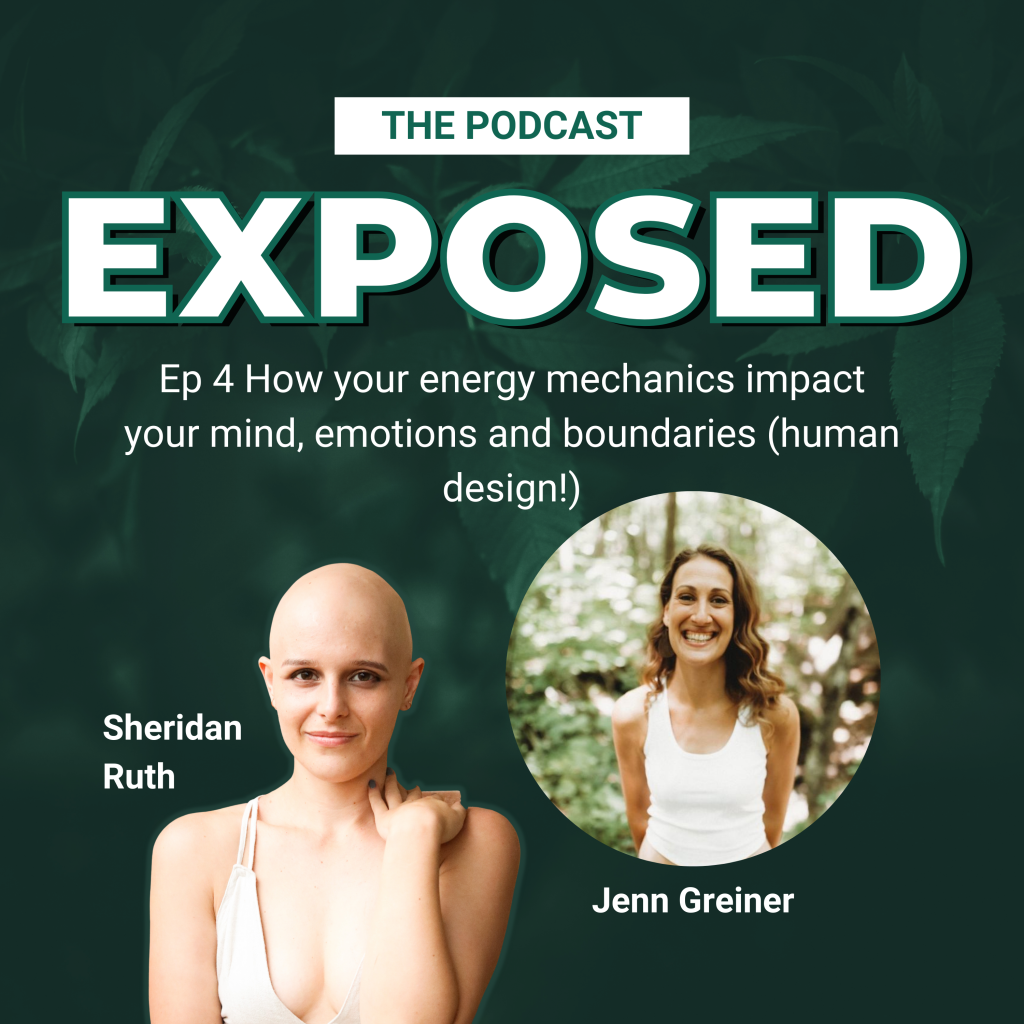
Episode 4: How Your Energy Mechanics Impact Your Mind, Emotions And Boundaries (Human Design!) With Jenn Greiner

Podcast

Listen Wherever You Get Your Podcasts

Today we’re clearing up the confusion around feeling emotions that might not even be yours and how energy – specifically your personal energy blueprint (human designs) changes the boundaries you most need, how you align in relationships, feel emotion, pressure, fear and find inspiration… thank you to Jenn Greiner for this chat!

Today, we’re discussing:

  • How your energy mechanics impact your mind and emotions  
  • Working with a coach to access their energy mechanics 
  • How your energy can help you align in relationships with self & others, and how to put yourself & their needs first.
  • How to manage emotions and process them, what to do if you’re getting sucked into other people’s emotions 
  • How to deal with root pressure 
  • Pressure coming from thoughts 
  • How to discern the voices in your system 
  • What to do if you have endless questions 
  • The most important boundaries for your energy mechanics

Connect with Jen: 

Jenn Greiner of Divine Vitality is a Vitality Coach, Licensed Counselor & Art Therapist with 10 years of experience in Mental Health. She utilizes Human Design to help individuals break relationship patterns to decondition & stand in their power for improved communication & relationships.


Jennifer Greiner @thevitaljenn, www.DivineVitalitywithJenn.com

Book a free 30 min Discover/Connection call!

https://calendly.com/divinevitalitywithjenn

Book a mini reading: https://calendly.com/divinevitalitywithjenn/mini-session?back=1&month=2023-01 

Self-Care Checklist when you sign up for my monthly newsletter

https://divinevitalitywithjenn.com/opt-in


Jenn Greiner of Divine Vitality is a Vitality Coach, Licensed Counselor & Art Therapist with 10 years of experience in Mental Health. She utilizes Human Design to help individuals break relationship patterns to decondition & stand in their power for improved communication & relationships.


Connect with Sheridan: 

Book your expansion call 

Connect on Instagram 


Are you ready to expose the truth about a body-based approach to health, wealth and love? Subscribe to EXPOSED today + invite a friend by sharing this episode. 

Request an episode by emailing sheridan@sheridanruth.com or IG DMing me at @_sheridanruth_

Episode 3: How Trauma Can Impact The Construction Of Our Identity And Authenticity With Devin Brooks

Podcast

Listen Wherever You Get Your Podcasts

Have you ever felt – different-, not enough, or as if you were missing parts of yourself? Or, have you ever declared yourself as not something or 100% something else? Eg. “I’m not musical” or “I’m an anxious person.” Today’s episode talks with Devin Brooks an Integrative Somatic Trauma Therapist and Music Therapist on the themes of trauma, identify and the missing parts of ourselves. We touch on queerness, hair loss and the depth of who we are.

Trauma, Authenticity and Identity: 

  • Trauma & Identity: Trauma can alter the course of identity development. Survival will always override the human development of the sense of self.
  • Trauma & Identity: It impacts the question: WHO AM I? My hopes and fears, likes and dislikes. It can impact the way an individual (a community) sees themselves in relation to the world. Feelings of I am not good enough, I am not lovable, I am bad.
  • Trauma & Identity: Dissociation can impact the development of sense of self. Feeling like you are missing parts of yourself. Not recognising yourself. Being unable to remember parts of your childhood.
  • Trauma & Identity: Authenticity is impacted. It is not safe to have a voice. The world is a scary place to explore and find your place in it. It is not safe to be vulnerable and lower defences. Being yourself is unsafe for many in the queer community.

Connect with Devin: 


Instagram: @talk.trauma

Website: www.talktrauma-devinbrooks.com


Devin is an experienced Integrative Trauma Therapist with a foundation in clinical music therapy and somatic trauma therapy. They are proud of their Queer and Gender Queer identity and advocates for the empowerment and equity of the LGBTQIA+ community. They are an international speaker on the topic of trauma and recovery as well as a member of the World Federation of Music Therapy Global Crises Intervention Commission supporting global communities during large scale traumatic events. He works in private practice with individuals from around the world through his online business Talk Trauma.


Connect with Sheridan: 

Book your expansion call 

Connect on Instagram 


Are you ready to expose the truth about a body-based approach to health, wealth and love? Subscribe to EXPOSED today + invite a friend by sharing this episode

Request an episode by emailing sheridan@sheridanruth.com or IG DMing me at @_sheridanruth_

Episode 5: From “Careful Not To Gain Weight” To Body Love At All Phases Of Life With Abbey Heagney

Podcast

Listen Wherever You Get Your Podcasts
This episode is for you if you’ve ever felt the stabbing pain of an innocent comment similar to “careful not to gain weight” or you find yourself emotional eating and just disliking your body. At the end you’ll receive 3 prompts you can use today (yay!) to transform your relationship with your body and start enjoying what you see in the mirror!

Today, we’re discussing: 

  • How a comment like “be careful not to gain weight” completely changed the trajectory of her life 
  • When you think you’re healthy … but you’re actually not! 
  • How this relates to hair loss and other aspects of your appearance 
  • The terror of gaining weight in pregnancy 
  • How to manage emotional eating 
  • Allowing yourself to be uncomfortable 
  • Prompts for changing your relationship with your body 
    • Is it true? Can I 100% know it’s true 
    • Find what you’re proud of
    • How can I be happy right now? 

Your next steps: 

  1. Write your narrative and find evidence for your new health and body story 
  2. Click here to book your free consultation with Abbey

Connect with Abbey: 

abbeyh@wellnesswithabbeyh.com

https://www.wellnesswithabbeyh.com/coaching

https://www.instagram.com/wellnesswithabbeyh

Abbey Heagney is a board-certified (NBC-HWC) health and mindset coach and owner of Wellness with Abbey. Abbey believes that all women deserve to feel healthy and confident in their body – while living the life they love. Through her private coaching practice, Abbey works 1:1 with women to help them find their own unique confidence by creating simple and effective healthy habits that work for them, their lifestyle and their goals. There is no one-size fits all cookie cutter approach – she honors your individuality and believes so deeply that no matter where you are starting or what you’ve tried in the past, it’s possible to achieve any goal you set for yourself. 

Connect with Sheridan: 

Book your expansion call 

Connect on Instagram

Episode 6: What My Partner Really Thinks About My Alopecia

Podcast

Listen Wherever You Get Your Podcasts

What do husbands really really really feel inside and think when they see us bald? Andres and I sit down to talk about how our relationship began, the secret thoughts we have about my alopecia and the real, raw stuff no one’s talking about with hair loss and love.

A man’s perspective on alopecia in women: 

When I was younger, I thought that no man would really be able to love me because of my alopecia. When I got my first boyfriend people would say “Oh, you’re so lucky you’ve found a man who loves you even though you have no hair” and my heart would sink. Today, the story is much different and I have a man who is proud of my appearance and my journey to get here. My name is Sheridan and I have Alopecia Universalis. My partner’s name is Andres and this is his perspective on my Alopecia. 


In the 4 and a half years we’ve been together, Andres has immersed himself in understanding the experiences of other people and my own. When we were asked about how it affects him emotionally he said: “I don’t think that I struggle with Sheridan not having hair. What I struggle with the most is how it makes her feel sometimes. It’s difficult to see when she’s hurt because it isn’t her fault. Sometimes it’s hard for me to support her because she needs me to understand alopecia to a level that someone who doesn’t have it cant understand. Sometimes what she needs is to speak with someone who DOES have alopecia. ” 


“One time I got in an Uber and was chatting driver about Sheridan. The diver asked to see a picture of her and when she saw Sheridan didn’t have hair, she said: Oh, she is very pretty, but isn’t it difficult to be with someone without hair? doesn’t she feel down all the time?’ and I said, “Sometimes she can have her days but it’s not like she’s depressed all the time, I love her and just like you said, she is very pretty”. 


When we have alopecia, for some people it can be really hard to find love, and confidence and feel connected to your romantic partner. I’ve learnt that the best thing you can do when you’re grieving your hair/identity/appearance is to ask your partner for what you need and try to understand each other. After that, the best thing you can do is work on your own self-love and owning your confidence and BEAUTY that radiates from the inside. I’ve never met a man to say that I’m not attractive because of my hair – quite the opposite. I attribute this to the confidence I’ve created from the inside. 


Andres’ advice to those in relationships who are supporting someone with alopecia would be to approach everything with curiosity and never assume what could or couldn’t be important to your partner. Don’t assume that because they got out bald doesn’t mean they won’t care if they lose their eyelashes – that’s a mistake I made and now I see how important it was to Sheridan. Try not to assume how they’re feeling – just ask. 


The words above were recently published in Bald Life Magazine and inspired by your amazing feedback, Andres and I have FINALLY done a Q and A. 

The Questions we answer

  1. How did you meet? 
  2. How long have you been together?
  3. Did your partner educate themselves on alopecia/treatments or was it mainly on you to explain to them? If they did their own research, any resources he would recommend as someone who is trying to understand? My bf doesn’t know how to start researching and it can be exhausting for me to explain possible treatments, and prognoses, and put my feelings aside to be an unbiased source of info for him. Also, how does he express his feelings to you about it? Would love to hear his struggles as my bf is taking it harder than me. I have a hard time comforting him when I’m the one that wants to be comforted sometimes. Lol.
  4. What do husbands really really really feel inside and think when they see us bald? And How they cope with that too
  5. What can a husband or wife do to help with the grief of losing your hair and still make them feel wanted?
  6. My husband prefers the look on me but it’s the stares and not feeling pretty.
  7. For him: How much does your partner losing their hair change or affect your intimate attraction to them? 
  8. For her: what are some ways to keep yourself feeling sexy and feminine? 
  9. How did you tell Andres’ family?
  10. Have there been situations where he felt called to explain something or be defensive on your behalf? 
  11. I have a husband who naturally started losing his hair at age 30 and supported him by not making his hair a big deal and made him feel cherished/ loved /attractive by sharing with him I liked his bald head. When my son was diagnosed with AU 3 years ago… I basically did the same thing. Do you think this approach is helpful? (I looked directly at my son’s eyes when I spoke to him … not directly at his head, even when I sometimes felt like that was difficult at first) Or do you think it’s better to approach things more head-on?

Access Embodied Confidence and Sexy, Feminine and Unstoppable – the masterclass bundle named “better than therapy” and “the most empowering thing I’ve ever done for my hair loss” by recent participants. Click here. 

Enquire about Acceptance & Confidence Ascension the only holistic program for women with hair loss to find acceptance and feel sexy with and without hair. Click here. 


Are you ready to expose the truth about a body-based approach to health, wealth and love? Subscribe to EXPOSED today + invite a friend by sharing this episode

Episode 7: Treating Treatment-Resistant Anxiety With Energy Work, Ancient Wisdom & Modern Science With Noemi Sparks

Podcast

Listen Wherever You Get Your Podcasts

When you’ve tried #allthethings to support your anxiety or pain and you feel like you’re running your wheels getting nowhere it’s exhausting and disheartening. Today, EFT Practitioner Noemi Sparks and I are talking about treatment resistant anxiety and how to know if energy work can support you.

Today, we’re discussing: 

  • What energy REALLY is and why you need to care about it 
  • Symptoms to look out for that tell you if you need energy or anxiety work 
  • The power of community and when you need it 
  • Managing a business, to-do lists around hormones as women 
  • A Return to You, that helps people release old energy and tap into their true selves. 
  • EFT tapping 
  • Energy in the body 

Connect with Neomi: 

Noémi Sparks, IG: @IAmNoemiSparks

Patreon.com/noemisparks

Noemisparks.com

Get 1 free group tapping with me at my Sunday tapping circle with the code IAMFREE thru noemisparks.com/classes


Connect with Sheridan: 

Book your expansion call 

Connect on Instagram 


Are you ready to expose the truth about a body-based approach to health, wealth and love? 

Subscribe to EXPOSED today + invite a friend by sharing this episode 

Request an episode by emailing sheridan@sheridanruth.com or IG DMing me at @_sheridanruth_

Ep 8: What To Do When Your Partner Triggers You 

Podcast

Listen Wherever You Get Your Podcasts

In this episode bring you a 6-step framework for transforming triggers into authentic connections that will guide you from confusion, tension and emotional turbulence towards clarity, connection and pleasure. 

Does this sound familiar?

  • He left his socks on the floor again. You snap at him / make a critical comment. You’re sitting on your bed making a pros/cons list because it feels like he doesn’t care. He’s just wasting your time and you should probably just leave.
  • You get triggered by an event and don’t know how to manage it, which leads you down a spiral of relationship anxiety, rumination, and doubt – and eventually, you either collapse in shame or deflect and attack your partner. 
  • You keep having a fight where you’re seemingly speaking totally different languages. 
  • You feel immediate tension in your chest when your beloved suggests a romantic getaway and sees it as a sign you need to leave. 
  • When your partner disappoints you, you see panic instead of alchemizing the moment into deep presence and connection.

What is a trigger? 

There are 2 ways to look at this. 

  1. Something that activates an emotion or energy inside. An event that occurs has a strong emotional reaction. Not necessarily negative. 
  2. From a trauma perspective, it can also be something that propels you back into a state where you perceive you are in the traumatic experience. 
  3. In general, regardless of whether it is a trauma-activating event or not, it is an event where you go from neutral, to having urgency, aversion or a desire for a certain thing to be true. 
  4. It points us to a belief we have that may be somewhat one-sided or a pain, or conflict inside of us. 
  5. Triggers occur out of a love of truth and bring light to an internal conflict. 
  6. This also means that when you trigger someone else it is simply shining a light on a pain inside of them. 
  7. Eg. if I say something you are already insecure about you will get triggered 
  8. “We think that if that one thing is true then the rest is a lie”
  9. We have to become better at holding different truths are empowering at different times. Expanding into a different view. Noticing where you are standing in the view of someone else eg. social media,  your Mumetc. Come back into alliance with your own truth and your partner. 
  10. This process of expansion is quite uncomfortable at times. 
  11. We also expand our capacity to handle discomfort around other people’s decisions 

What to do: 

  1. Get regulated – use the EASE method – DM me for the PDF 
  2. Emotional alchemy – move the energy from the pain above 
    1. What am I aware of? Sensations, emotions, thoughts
    2. What ELSE am I aware of? Get curious 
    3. What am I making this energy mean? 
    4. Could I move this energy out of my body? Could I embrace, care for and love this energy? Could this energy even be connected to pleasure? 
  3. Look at where you are holding beliefs and truths about life that could be conflicting and expand into the version of yourself that can hold all of these truths/possibilities. This might look like seeing things through different lenses, seeing the world through your partner’s eyes, through the lenses of the different parts of yourself. Nourish the parts of you that are in pain. 
    1. What am I making this mean and why would it be so terrible if it were true? 
    2. Arrive at the belief. Eg. “if that were true I would need to…” 
    3. If that were true, why would that be so terrible? Keep going. 
    4. You might land on a memory of when you learned that that’s your truth. Nourish that part of you, make it feel safe. 
  4. Expand into the sensations of sitting with the discomfort of their pain and allow it to be there, allow it to be okay – stay regulated. 
    1. Find relief and follow it. 
  5. Align with your values, your view and yourself and want to embody and experience instead and take a loving action according to that. 
  6. Begin cultivating a sense of relief and safety inside, it’s a skill. It lives in you, come home to it. 

What’s next? 

Now that you have the foundations, it’s time to apply this to your life and see changs. You’re about to receive a tried and tested framework that works with your mind, body and soul so that you can actually see some changes in your life and through your triggers. 


Introducing… What To Do When Triggered


A 2 hour workshop, we bring together the most important aspects of body-based regulation and inner enquiry so that you can spend less time ruminating over your relationships or going back and forth in fights that you’ve had a million times and more time cuddled up on the couch and out dancing with friends. 


In this immersive 2 hours workshop, I bring you a 6-step framework for transforming triggers into authentic connections that will guide you from confusion, tension and emotional turbulence towards clarity, connection and pleasure. 


Click here to transmute your triggers. 


Podcast Music Composer – Upturned: 

For enquiries about custom composition for podcasts and audio-visual projects please email upturnedduo@gmail.com


Share/review: 

HELP EXPAND THIS PODCAST

I share this show from the bottom of my heart to help people find a free and easy way to return to their hearts. If you love this show and want a free and easy way to help it grow, the most effective way you can help is to:

  1. Subscribe to the show by clicking “subscribe” on iTunes or “Follow” on Spotify.
  2. Write a review on iTunes
  3. Share this show with one friend right now!

These simple and quick actions help this project reach more people. The algorithm uses ratings and reviews to know who to show our show to in their app. Thank you for your support. 

With love,

Sheridan

Ep 9: The Unexpected Connection Between Money And Your Nervous System 

Podcast

Listen Wherever You Get Your Podcasts

Money can be really complicated. 

It represents our most primal survival needs and therefore becomes inherently activating to the nervous system. 

Mindset work isn’t enough – nor is education.

And it certainly isn’t just about willpower and the correct budgeting app. 

Your relationship to your money (or lack thereof) is mapped throughout your nervous system, attachment style and most subconscious beliefs. 

In this podcast episode, you’ll learn how to untangle and reconfigure your complex relationship with money (through nervous system subconscious work, and with respect to your trauma around money) and your next steps to receiving, circulating and saving money with confidence. 

Applicable for entrepreneurs and all other people. 

In this podcast on money and the nervous system you’ll find: 

  • How the nervous system is related to money 
  • Attachment and money 
  • Burnout and dysregulation 
  • The science behind intergenerational patterns/trauma 
  • Your window of tolerance 
  • The energy of money 
  • Money and identity 
  • The subconscious and money 
  • Subconscious message that they aren’t trustworthy to hold money eg emotional and irresponsible 
  • A somatic equiry on receiving money 
  • Your new money experience 

What’s next? 

Only an untangling and reconfiguration of your complex relationship with money (through nervous system subconscious work, and with respect to your trauma around money), can you increase your capacity to receive, circulate and save money with confidence. 


If you’re ready to say bye-bye to awkward conversations (and even fights) about your savings account and hold your breath as you swipe your credit card, keep reading. 


There’s a solution (that will work) waiting for you.


Financially Fierce – reconstruct your nervous system’s relationship with money to increase your capacity to hold, spend and receive. 

Click here: Become Financially Fierce Today

Podcast Music Composer – Upturned: 

For enquiries about custom composition for podcasts and audio-visual projects please email upturnedduo@gmail.com


Share/review: 

HELP EXPAND THIS PODCAST

I share this show from the bottom of my heart to help people find a free and easy way to return to their hearts. If you love this show and want a free and easy way to help it grow, the most effective way you can help is to:

  1. Subscribe to the show by clicking “subscribe” on iTunes or “Follow” on Spotify.
  2. Write a review on iTunes
  3. Share this show with one friend right now!

These simple and quick actions help this project reach more people. The algorithm uses ratings and reviews to know who to show our show to in their app. Thank you for your support. 

With love,

Sheridan