
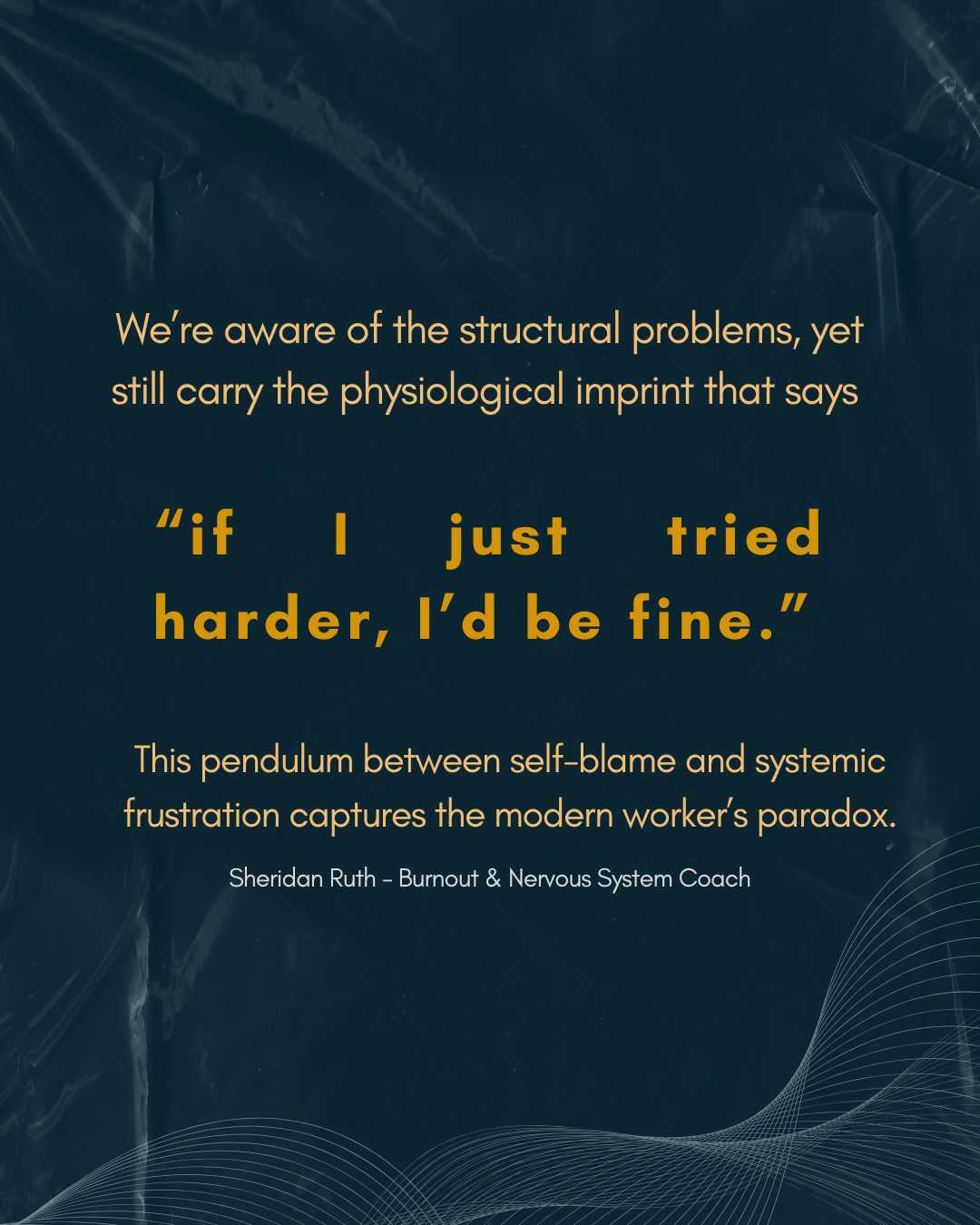
Here, we explore the question:
How do sensitive, neurodivergent, and trauma-aware professionals experience and navigate the friction between their nervous-system needs and the systemic demands of modern work — and what practices help restore alignment between the two?
Why Work Feels Harder Than It Should:
Over the past fifteen years, I’ve sat on every side of the work equation — employee, entrepreneur, coach, and researcher. I’ve been told I was “too much,” “too sensitive,” and once, when I was 17, even “too Latina”… simply because I asked for my break on time. That was my first taste of how difference (and humanity) gets pathologised instead of understood.
Since then, I’ve supported hundreds of professionals (many neurodivergent, trauma-aware, or quietly burning out) to rebuild clarity, calm, and confidence in how they work. And through my own cycles of collapse and renewal, one truth keeps surfacing: the problem isn’t that we’re broken. It’s that our bodies and workplaces have different, conflicting needs.
We live inside systems that reward endurance while our biology depends on rhythm. Growth-at-all-costs culture, rising living expenses, and the constant demand to prove value all shape how our nervous systems function at work. Research confirms that burnout arises not from weakness but from a mismatch between human design and work design (Maslach & Leiter, 2016).
AI disclaimer: AI was used only for the practical parts, transcribing interviews and helping me condense sections for readability. I did all the reviewing, theme-finding, and analysis myself, and the final perspective is fully human-developed from my own research and interpretation.
Quick Summary: Your Nervous System Is Trying to Help You Survive, Not Thrive
Across forty conversations in design, tech, health, and entrepreneurship, one pattern echoed: people doing a “good job” yet feeling nothing — a tired-but-wired loop of overthinking, insomnia, and quiet frustration.
“Sometimes it feels like I’m walking a tightrope — trying not to inconvenience others.” — Nancy
“I’m not overworked — I’m under-challenged. I’ve graduated from my job.” — Caroline
Burnout isn’t one state. It’s an oscillation between drive and depletion. Most people aren’t disengaged; they’re overloaded by ambiguity and under-resourced by recovery. These sensations are biological, not moral. The body is trying to keep you safe. Under chronic stress (economic uncertainty, AI disruption, constant evaluation) it diverts energy from creativity toward survival. Awareness helps, but safety must come before strategy.
Regulation in practice looks like pacing, clarity, and honest limits; the baseline becomes:
“I can handle what comes next.”
Research from neuropsychology and Polyvagal Theory confirms that without perceived safety, the brain prioritises defence over problem-solving (Porges 2011; McEwen 1998).
When people finally experience true safety — a part-time role, a peer circle, or a manager who sees their humanity — creativity returns.
“They quickly created a part-time role for me… realizing my value made me take the gas off myself.” — Elizabeth
How Somatic Coaching Supports Burnout Recovery
We’re living through relentless change. AI is reshaping industries, economies feel unstable, and traditional career paths are dissolving. The question underneath almost every interview was:
“What do I do when it feels like the rug has been pulled out from underneath me?”
Adaptability (not certainty) determines who thrives. And adaptability is physiological.
A regulated nervous system can distinguish challenge from threat, recover faster, and make clear decisions in uncertainty. That’s why somatic coaching is not a luxury, it’s a practical, evidence-based approach to burnout recovery for sensitive professionals and leaders.
Somatic work teaches the body to stay curious under pressure, to recover after activation, and to re-establish internal safety so you can perform sustainably.
“High achievers don’t know when to switch off… we take on too much until it’s too late.” — Katherine
Over time, this work builds confidence: I can meet what’s next.
7 Somatic Experiments to Try This Week
Even the most insightful awareness means little without integration.
Below are seven short, evidence-informed somatic experiments for high-functioning professionals rebuilding capacity after burnout.
- When you feel emotionally flooded or reactive
→ Pause and name one emotion or body sensation; breathe into it without fixing.
People often find the feeling completes itself and calm returns. - When you’ve just had a win and feel yourself shrinking or self-sabotaging
→ Orient to one pleasurable or grounded sensation for 17 seconds.
People often find it teaches the body that ease and success are safe. - When you’re stuck overthinking a decision
→ Notice sensations as you imagine each option; choose what feels lighter or calmer.
People often find quiet confidence replaces analysis paralysis. - When you’re procrastinating or lost in perfectionism
→ Try a small “experiment in spontaneity” — send the imperfect draft or take a new route.
People often find it rewires the nervous system to feel safe being visible again. - When you’re tense after feedback or structure feels unsafe
→ Say, “I have agency now.” Adjust one small element — a boundary, a deadline.
People often find their breath steadies and autonomy returns. - When you feel disconnected or uninspired
→ Embody a supportive belief (“I can trust myself”) and ask, “What’s my next natural action?”
People often find grounded motivation replaces forced effort. - When your body feels agitated or overactivated
→ Try cross-body movements — right hand to left shoulder, then alternate.
People often find focus and balance return within minutes.
Adaptability isn’t built through control; it’s built through relationship. The more predictable signals your nervous system receives (through rituals, rest, and self-dialogue) the more fluidly you can move with uncertainty instead of against it.
When to Seek Support
If you notice chronic exhaustion, irritability, indecision, self-criticism or emotional flatness even after rest, your system may need guided support.
A nervous system coach can help you regulate, rebuild trust in your body, and design work rhythms that sustain focus and wellbeing.
Book a Curiosity Call — a free 20-minute chat to explore what’s coming up for you and whether somatic coaching could support you.
Or, if you’re ready for structured support, join the 5-Week Somatic Pilot Program — designed for sensitive and neurodivergent professionals rebuilding clarity, calm, and energy at work. 🤍
FAQ
Q: Why do I still feel burnt out even after rest or therapy?
A: Because burnout isn’t just mental. It’s physiological. When your nervous system never feels safe enough to rest, it stays in survival mode even when you stop working.
Q: How can I recover from burnout without quitting my job?
A: By rebuilding capacity — through stopping earlier than your mind wants to, clear boundaries, and body-led regulation that lets your system handle stress without collapse.
Q: What does nervous system regulation mean in burnout recovery?
A: Nervous system regulation means teaching your body how to move between stress and rest without getting stuck in either. During burnout, your system can lose flexibility — staying in fight, flight, or freeze long after the stressor is gone. Regulation practices (like breath pacing, gentle movement, clear boundaries, and grounding rituals) rebuild that flexibility. Over time, your body learns that it’s safe to slow down, focus, and rest — which restores energy, attention, and emotional steadiness.
Q: How can I rebuild my energy after chronic work stress?
A: Real recovery starts with rhythm, not more effort. Instead of trying to push through exhaustion, begin by restoring predictable patterns: steady sleep, nourishing meals, gentle movement, and moments of genuine pause. These cues tell your body it’s safe to produce energy again. From there, focus on pacing — stop before collapse, transition between tasks slowly, and track what feels energizing versus depleting. Over weeks, this creates a sustainable baseline where motivation and creativity return naturally.
Q: Why isn’t rest alone enough to recover from burnout?
A: Rest helps you pause, but it doesn’t automatically rewire the patterns that caused burnout in the first place. Many people rest but stay in “survival mode,” meaning the body never truly feels safe enough to restore energy. Recovery happens when you pair rest with regulation — pacing, clear boundaries, gentle structure, and support that helps your nervous system feel safe in both action and stillness. That’s when rest starts to rebuild rather than just relieve.
Q: What’s the difference between burnout and depression?
A: Burnout and depression can overlap — both can bring exhaustion, low motivation, or numbness — but they come from different roots. Burnout is a stress-related state that improves when the source of chronic pressure changes and the body feels safe again. Depression is broader, often involving changes in mood, sleep, and appetite even without external stressors. If symptoms persist despite rest or support, professional mental health guidance can help you understand what’s really happening beneath the surface.
Q: What if it’s not the right time to make big changes?
A: That’s okay — recovery doesn’t have to mean quitting your job or overhauling your life. It starts with micro-adjustments inside your current reality. Notice where you can add a little more space — a slower morning, a deeper breath before responding, or saying “let me think about it” instead of a reflexive yes. When you work with your capacity rather than against it, your body begins to trust you again. That trust becomes the foundation for knowing when the right time will come.

Written by Sheridan Ruth
Sheridan Ruth is a psychology-trained somatic coach, researcher, and bestselling author whose work bridges nervous system science and sustainable success. Through qualitative research and coaching practice, she helps sensitive, neurodivergent, and trauma-aware professionals recover from quiet burnout, rebuild capacity, and create body-aligned ways of working. Her integrative frameworks draw from Polyvagal Theory, emotional alchemy, and organizational psychology — offering a grounded, evidence-informed path toward clarity, creativity, and calm.